Linked List Cycle
LeetCode 141 | Difficulty: Easy
EasyProblem Description
Given head, the head of a linked list, determine if the linked list has a cycle in it.
There is a cycle in a linked list if there is some node in the list that can be reached again by continuously following the next pointer. Internally, pos is used to denote the index of the node that tail's next pointer is connected to. Note that pos is not passed as a parameter.
Return true* if there is a cycle in the linked list*. Otherwise, return false.
Example 1:
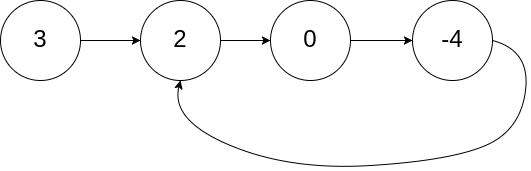
Input: head = [3,2,0,-4], pos = 1
Output: true
Explanation: There is a cycle in the linked list, where the tail connects to the 1st node (0-indexed).
Example 2:
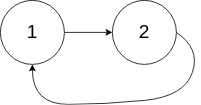
Input: head = [1,2], pos = 0
Output: true
Explanation: There is a cycle in the linked list, where the tail connects to the 0th node.
Example 3:

Input: head = [1], pos = -1
Output: false
Explanation: There is no cycle in the linked list.
Constraints:
-
The number of the nodes in the list is in the range
[0, 10^4]. -
-10^5 <= Node.val <= 10^5 -
posis-1or a valid index in the linked-list.
Follow up: Can you solve it using O(1) (i.e. constant) memory?
Topics: Hash Table, Linked List, Two Pointers
Approach
Hash Map
Use a hash map for O(1) average lookups. Store seen values, frequencies, or indices. The key question: what should I store as key, and what as value?
Need fast lookups, counting frequencies, finding complements/pairs.
Linked List
Use pointer manipulation. Common techniques: dummy head node to simplify edge cases, fast/slow pointers for cycle detection and middle finding, prev/curr/next pattern for reversal.
In-place list manipulation, cycle detection, merging lists, finding the k-th node.
Solutions
Solution 1: C# (Best: 165 ms)
| Metric | Value |
|---|---|
| Runtime | 165 ms |
| Memory | N/A |
| Date | 2017-09-22 |
/**
 * Definition for singly-linked list.
 * public class ListNode {
 *     public int val;
 *     public ListNode next;
 *     public ListNode(int x) {
 *         val = x;
 *         next = null;
 *     }
 * }
 */
public class Solution {
    public bool HasCycle(ListNode head) {
        if(head==null || head.next == null) return false;

		ListNode slow = head, fast = head;
		while (true)
		{
			slow = slow.next;
			if (fast.next != null)
			{
				fast = fast.next.next;
			}
			else return false;
			if (slow == null || fast==null) return false;
			if(slow == fast) return true;
		}
    }
}
Complexity Analysis
| Approach | Time | Space |
|---|---|---|
| Two Pointers | ||
| Hash Map | ||
| Linked List |
Interview Tips
- Start by clarifying edge cases: empty input, single element, all duplicates.
- Hash map gives O(1) lookup — think about what to use as key vs value.
- Draw the pointer changes before coding. A dummy head node simplifies edge cases.